The science behind the run-walk method
Walk breaks feel like a shortcut. They're actually the engine of the whole program — and there's solid physiology behind why they work so well for beginners.
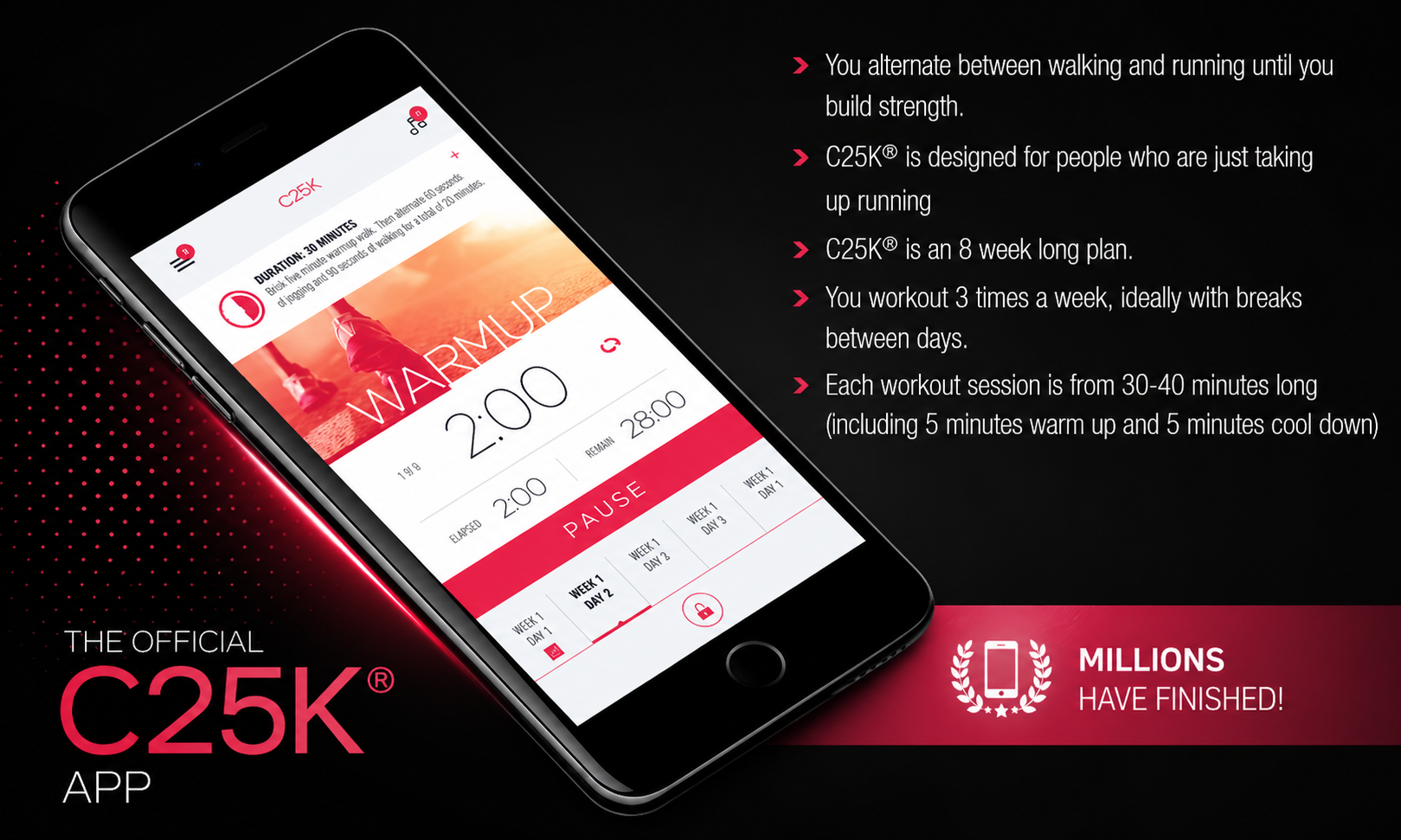
When Josh Clark designed Couch to 5K in 1996, he made one quietly radical decision: don't ask new runners to run. Ask them to alternate short jogs with walking, and stretch the jogs a little each week. Thirty years and millions of finishers later, that decision still holds up — and modern exercise science explains why.
Your heart adapts faster than your joints
Cardiovascular fitness improves remarkably quickly — you can feel the difference in a couple of weeks. But tendons, ligaments, and bones remodel far more slowly, over months. The single biggest risk for a new runner is doing too much before that connective tissue catches up. Walk breaks throttle the load on your joints while still training your heart and lungs, letting the slow-adapting tissues strengthen at their own pace.
The walk break isn't recovery from failure. It's the part of the workout that keeps you healthy enough to come back tomorrow.
Intervals let you do more total work
Here's the counterintuitive part: by breaking a session into intervals, you accumulate more running than you could in one continuous effort. A beginner who tries to run non-stop fatigues, slows, and stops at eight minutes. The same beginner doing 60-second jogs with walk breaks can easily total fifteen minutes of running in a session — and finish feeling capable rather than crushed.
It manages the thing that quits first: motivation
Most people don't quit running because their body fails. They quit because the experience feels miserable. Run-walk keeps every session inside the "I can do this" zone. Each walk break arrives just before things get truly hard, so you end on a high instead of a struggle. That emotional pattern — finishing strong, week after week — is what builds a runner.
The gradual progression is the genius
- Week 1: 60-second jogs. Almost anyone can do 60 seconds.
- Week 3: three-minute jogs appear, and they feel manageable because your base has grown.
- Week 5: a 20-minute continuous run — a number that would have been absurd on day one.
- Week 8: 30 minutes, a full 5K. The walk breaks did their job and quietly disappeared.
None of it relies on willpower or talent. It relies on a progression slow enough that your body never gets the memo that it's doing something hard. That's not a shortcut — it's just good engineering. And it's why pressing start three times a week is genuinely all it takes.